

Full-service restaurants
Restaurant management software for full-service restaurants
One system for the floor, the kitchen and the back office, so every plate that leaves the pass also moves stock and food cost.

A full-service restaurant runs two businesses at once. On the floor it is a chain of small promises: the bread arrives first, the mtsvadi follows the salads, and the check at the end of a long supra is split exactly the way the table wants. Behind the kitchen door it is a ledger of beef, butter, wine and gas that has to add up at the end of the month.
Most restaurants run those two halves on different tools. The POS knows what was sold, a spreadsheet knows what was bought, and somebody reconciles the two late and by hand. Wox is built so that both halves read and write the same data. Here is what that looks like across an ordinary day.
Where table-service restaurants lose money
- Food cost that arrives a month late. When invoices and counts live in spreadsheets, the food cost percentage appears weeks after the week that caused it.
- Tickets lost between floor and kitchen. Paper tickets and shouted orders send courses out of sequence and drop modifications, and a remade dish is paid for twice.
- Supplier prices that creep. A little more per kilo of beef, repeated across several deliveries, can erase the margin on a dish nobody repriced.
- Exceptions without names. When anyone can void or comp an item, nobody can tell a mistake from a giveaway.
None of this is fixed by working harder. It is fixed when the floor and the back office record the same events at the moment they happen.
Service: tables, seats and courses
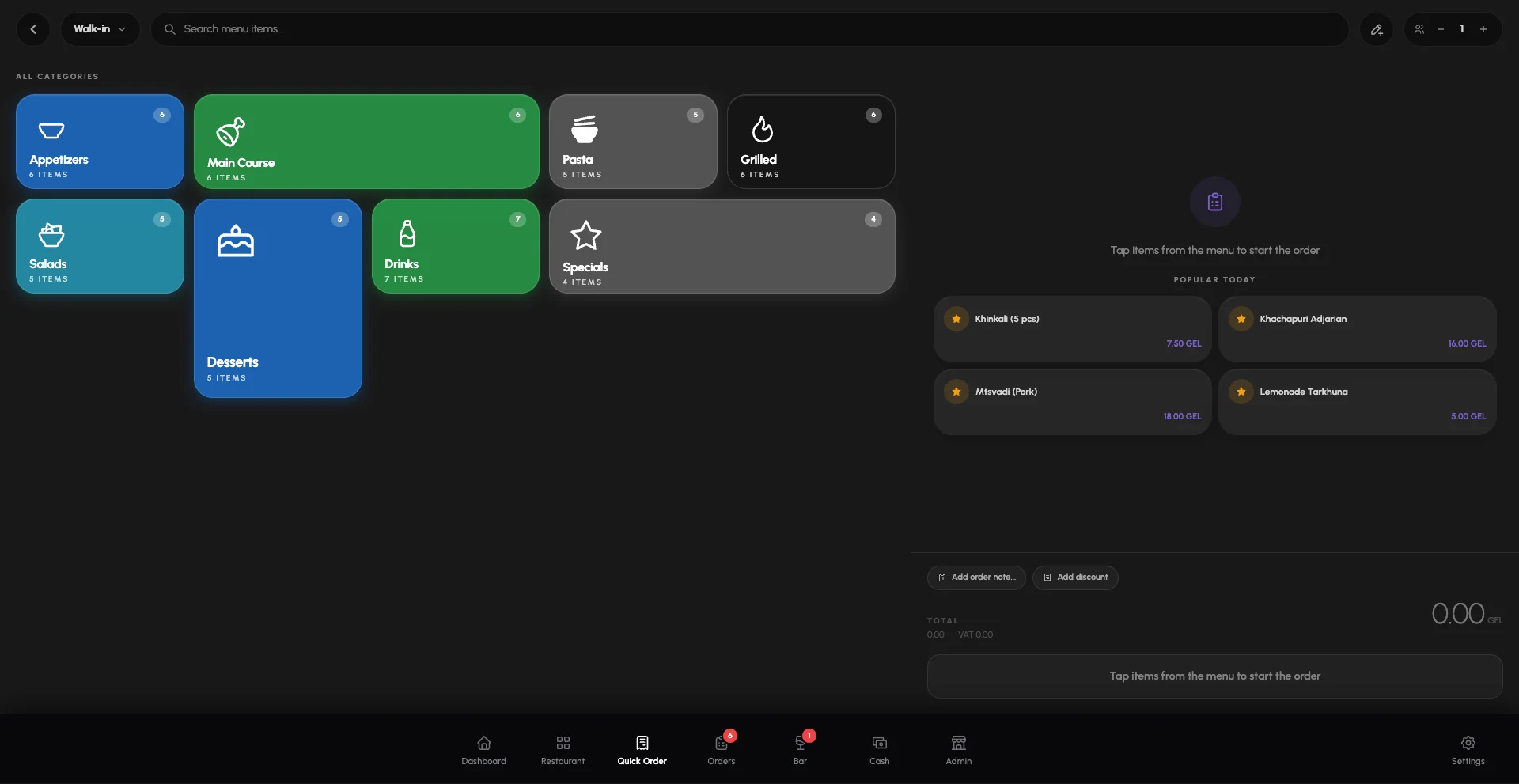
Service in Wox starts at the table map. The floor plan shows each table's status, its server, how far its order has got in the kitchen and the next reservation due. A waiter seats the party, assigns guests to seats and builds the order item by item, choosing modifiers from the dish's own options instead of typing them into a note.
Courses are part of the order, not something the kitchen has to guess. Starters can go straight away while mains wait on hold, and when the table is ready one tap fires the next course. Sent lines stay grouped by course and round on the check, so whoever picks up the table later can see what has gone out and what is still waiting.
When the internet drops, as it does in older buildings and on some busy streets, the POS keeps taking orders and payments in offline mode. The work is held on the terminal and syncs when the connection returns.
The kitchen: a display instead of paper
Fired lines go to the kitchen display, routed by station. The grill sees grill items, the cold kitchen sees salads, and the expo screen sees the whole order. Modifiers and allergens are on the ticket itself, and every ticket shows how long it has been waiting, with an alert when it runs late.
Cooks move a line to Ready with a tap, and a ticket bumped by mistake can be recalled. The floor sees the same status, so nobody walks into the kitchen to ask whether table seven's khachapuri is on its way.
Paying the check
At the end of the meal the check can be split by seat or by item, which matters for the table of eight that wants to pay three different ways. Cash, card or a mix of both are recorded against the check. The card itself is run on your card terminal, and Wox records the charge. Tips can be added on the payment screen, or the tip prompt can be switched off for a location that does not use it.
Voids, comps and discounts can require a manager's PIN. This is not about distrust. It means every exception carries a name and a reason, which is the only way to read a void report later and learn something from it.
Stock that moves with every plate
Each dish can carry a recipe: 180 grams of beef, 40 grams of onion, a spoon of tkemali. When the dish is sold, Wox deducts those ingredients from stock through the same ledger that records deliveries, waste and counts. The inventory screen therefore reflects service as it happens, not as it was last reconciled.
Counts still matter, because shelves never match a system exactly. A count records what is physically there, a manager reviews and approves it, and the difference becomes a clear over or short line rather than a silent overwrite. Waste is logged separately with a reason, so a dropped tray of lobio and an unexplained shortage never get mixed up. The inventory management guide explains the setup.
It is fixed when the floor and the back office record the same events at the moment they happen.
Food cost before the month ends
Because sales deduct stock and deliveries update costs, food cost is something you can look at on a Tuesday, not only in the first week of the following month. The food cost variance report compares what your recipes say you should have used with what your counts show you actually used. A gap on one item, a cut of pork or a tin of olive oil, points to a portioning or prep problem you can walk into the kitchen and fix.
Recipe costing keeps each dish tied to current ingredient prices. When a supplier raises the price of sulguni, the margin on every dish that uses it changes on screen the same day. For the background, read actual versus theoretical food cost and how to calculate food cost percentage.
 Wox
WoxAnalytics
March 2026 · Downtown
Food Cost
28.4%
↓ 1.6% vs target
COGS
$18.4k
↓ $1.2k MoM
Waste
$312
Stockouts
3
Top Spend Category
Proteins
38% of total spend
Price Variance
+2.1%
vs last month average
Built for how restaurants work in Georgia
Wox connects to rs.ge. When you link your Revenue Service account it imports twelve months of waybill history, then syncs every night. It proposes suppliers and matches waybill lines to your items, and nothing reaches stock until someone has reviewed it. With the rs.ge integration, the cost of beef in your recipes is the price on the waybill, not the price someone remembered.
Every location also gets a free QR menu that reads from the same menu as the POS, in Georgian, English and Russian. When a price changes in Wox, the menu guests open on their phones changes with it. Prices, costs and reports are in lari throughout.
Asking the numbers a question
On paid plans, Wox Analyst answers questions from your live data in Georgian or English: what sold on Saturday, which dishes lost margin this month, how far the drawer was short last week. It can propose changes, such as logging waste, setting a par level or taking a dish off the menu for the night, and nothing is applied until you confirm it.
Closing the day
At the end of the night a guided close takes the manager through open checks, staff clock-outs, the cash count, tips and the daily summary before the business day is locked. The cash count is compared with the drawer's own record of float, sales, drops and paid-outs, and any difference is recorded with a reason. The next morning starts from a clean, closed day.
Getting started
Most restaurants begin with the menu and recipes for their best-selling dishes, connect rs.ge next and then move the floor onto the POS. The getting started guide sets out the order. There is a Free plan, and paid plans start at 99 GEL per month. See pricing for what each plan includes, or book a demo to walk through your own menu. If you run several restaurants, the restaurant groups page covers multi-location setup.
Questions people ask
Does Wox replace my POS or work beside it?
Wox includes its own POS and kitchen display, so a full-service restaurant can run service, stock and reporting in one system instead of reconciling two.
Can I see food cost before the month ends?
Yes. Sales deduct ingredients by recipe and deliveries update costs as they arrive, so food cost and variance reports are available whenever you count, not only at month end.
What happens if the internet goes down during service?
The POS keeps taking orders and payments in offline mode. Work done offline is marked as pending and syncs when the connection returns.
Is there a free plan?
Yes. Wox has a Free plan, and paid plans start from 99 GEL per month. The QR menu is free on every plan. Wox Analyst is available on paid plans.
Step-by-step guides
Getting Started with Restaurant Inventory Software
A practical onboarding guide for operators launching restaurant inventory management software across one or more locations.
Restaurant Inventory Counting and Stock Management
Best practices for restaurant inventory management — storages, counts, low-stock control, and replenishment planning to reduce food cost.
Recipe Costing and Food Cost Percentage Tracking
How to link recipe costs to live invoice data so your food cost percentage stays accurate as ingredient prices change.
From the blog
How to Calculate and Control Restaurant Food Cost Percentage
Food cost percentage is the single most important financial metric for restaurant profitability. It measures how much of every revenue dollar goes toward the ingredients on each plate. For an industry where average net profit margins hover between 3% and 5%, even a one-point shift in food cost can mean the difference between a profitable quarter and a losing one. This guide explains exactly how to calculate food cost percentage, what the benchmarks are by restaurant type, and which operational strategies bring that number under control.
Actual vs. Theoretical Food Cost: How to Calculate and Track Variance
Most restaurant operators know their food cost percentage. Fewer understand why that number is what it is. Actual food cost tells you where you ended up. Theoretical food cost tells you where you should have been. The difference between the two—variance—tells you why. This guide explains how to calculate both, how to interpret the gap, and what to do when variance exceeds acceptable thresholds.
Restaurant Inventory Management: The Complete Guide for 2026
Inventory is one of the largest expenses a restaurant carries, typically accounting for 28% to 35% of revenue. Yet many operators still rely on pen-and-paper systems, spreadsheets, or inconsistent counting methods that leave thousands of dollars in waste, theft, and over-ordering invisible. This guide covers the fundamentals of restaurant inventory management, from counting methods and par levels to technology adoption and waste reduction.
Wox for other businesses
Full-service restaurants
See Wox with your own menu
Book a short demo and we will set it up around how your business actually runs, or start on the free plan today.